DIVINE Pilot 3 - Case Study
DIVINE Pilot 3 Case Study - Smart Farming Data in the Service of the New CAP Monitoring
Pilot Overview
Greece – Western Greece, Macedonia, Thrace
Cross-sectoral including olives and grapes. The pilot sites for olives are in Kavala and Agrinio, Greece, while the pilot site for grapes is in Amyntaio, Greece.
Target Stakeholders & Problems to be Addressed
This pilot addresses needs of farmers, farm advisors and CAP policy monitoring officials. Mechanisms for farm level data collection, aggregation and sharing are addressed resolving issues related to data quality, lack of interoperability, manual processing and unclear indicators. Furthermore, the success of the new CAP highly depends on data sharing policies and the respective technical means that will facilitate the collection of ground truth evidence. Among the key challenges to be addressed is the design and implementation of the appropriate data sharing policies for agricultural data that will regulate the exchange of data from the various FMIS (lock-in) and farmer reluctance to share data. This pilot action will enable the combination of FMIS data [Gaiasense smart-farming system] with other datasets simplifying the provision of ground truth and CAP compliance monitoring. Farmers benefit from sharing by gaining access to aggregated data from their region.
Key Activities
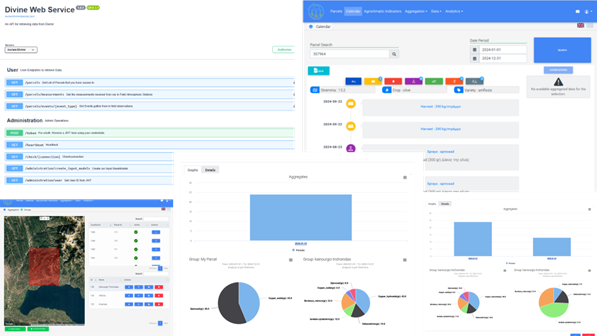
Pilot sites include 2 x different cultivate types, including 83 olive parcels (63,9ha) and 5 grape parcels (3,8ha). Data from these sites is collected and aggregated at parcel, farm and regional level. Data sources include 88 digital farm calendars and 10 IoT agro-environmental stations. Data collection is enabled through API for retrieving GaiaSense data and the implementation of AIM+ data translators for semantic interoperability. Based on data collections from farmers digital calendars automated calculation for a predefined set of indicators are provided. Key outputs include smart crop type identification, applied fertilisers, applied pesticides, applied irrigation and harvested yields. Analytics offer a range of agroclimatic indicators designed to optimise production including predictions related to temperature, humidity, leaf wetness, rain and wind velocity.
Data sets from the cultivation periods 2023–2025 have been utilised, along with data from earlier years, including 2022.
Outcomes & Impact
A total of 21 farmers engaged with the pilot during rounds 1 and 2, receiving customised data driven farming advice.
There are two main outcomes from this pilot case. The first one is the validation of innovative agricultural data sharing approaches, focusing on the improved efficiency and performance for CAP indicators monitoring; the capacity on combining and processing heterogeneous information; the reduction of administrative burden; the efficient and effective controls of aid applications and the acceptance of data sharing. The other outcome is the several potential benefits for farmers, such as faster payments, provision of regional statistics and farm-advisory services that will lead to reduced bureaucracy and right income allocation, and for Paying Agencies such as reduction of administrative burden, compliance with CAP targets/indicators, and achieved performance. Furthermore, enhanced decision support drives enhanced levels of farm production and boost sustainable practices through optimised use of pesticides, fertilizers and irrigation water.
Indicative results from the pilot activities demonstrate significant improvements in both productivity and resource efficiency. For grape cultivation, production increased by up to 102% over three consecutive years and by 55% across the two pilot rounds. Concurrently, reductions of 16% in irrigation and 46% in pesticide use were recorded. In the case of olive cultivation, production increased by at least 120% during both pilot rounds across the two pilot sites, accompanied by reductions of up to 24% in irrigation, 15% in fertilization, and 37% in pesticide use.